Dog Whelping Guide: Complete Handbook for Breeders
Complete whelping guide covering labor stages, emergency warning signs, puppy resuscitation, dystocia, and post-whelping care for professional dog breeders.
The dam's temperature just dropped below 99°F. You have roughly 24 hours before puppies start arriving. Are you ready?
Whelping — the process of a dog giving birth — is one of the highest-stakes moments in breeding. Even experienced breeders feel the weight of it. A study of canine neonatal mortality found that 75% of puppy deaths occur in the first week of life, with many tied directly to complications during or immediately after birth. The difference between a textbook delivery and a tragedy often comes down to preparation and knowing exactly when to act.
This guide walks you through every phase of whelping: the weeks before, the hours during, and the critical first day after. You will learn to recognize the difference between normal labor and an emergency, how to revive a non-breathing puppy, and when calling your veterinarian can save lives.
Preparing for Whelping: 2 Weeks Before the Due Date
Dogs are pregnant for approximately 63 days from ovulation. If you tracked breeding with progesterone testing, you can predict the due date within 1-2 days. Without progesterone data, expect delivery between 58-68 days from breeding.
Two weeks before the expected due date, your preparation should be complete.
The Whelping Box
Set up the whelping box at least one week before the due date so the dam can acclimate. The box should be:
- Large enough for the dam to stretch out fully with room for puppies along her belly
- Enclosed on three sides with an entrance low enough for the dam but high enough to contain puppies
- Equipped with pig rails — a ledge 3-4 inches from the floor and 3-4 inches from the wall that prevents the dam from accidentally crushing puppies against the sides
- Lined with washable, grippy material — incontinence pads or whelping pads tucked under the pig rails work well
Temperature control is critical. Newborn puppies cannot regulate their body temperature for the first two weeks. Keep the whelping area at 85-90°F (29-32°C) for the first week, gradually reducing to 80°F by week two and 75°F by week four. Use a space heater positioned safely away from the box, or place a heating pad under one section of the box so puppies can move toward or away from the heat.
Essential Whelping Supplies
Gather these supplies before labor begins:
For Delivery:
- Clean towels (at least a dozen)
- Bulb syringe for clearing airways
- Hemostats or unwaxed dental floss for umbilical cords
- Blunt-tipped scissors (sterilized)
- Surgical gloves
- Lubricating jelly (water-based)
- Digital thermometer
- Kitchen scale (grams)
For Emergencies:
- Oral calcium supplement (Calsorb or Cal Gel)
- Nutri-Cal or corn syrup (for hypoglycemia)
- Puppy milk replacer
- Feeding tubes or syringes (if tube feeding becomes necessary)
For Records:
- Whelping collars or different colored ribbons
- Notebook and pen
- Clock or timer
Critical Contact Information: Post these numbers where you can find them at 3 AM:
- Your regular veterinarian
- Emergency veterinary clinic (open 24 hours)
- A backup person who can help or drive
Pre-Whelping Veterinary Check
Schedule a veterinary appointment during the last week of pregnancy. Your vet should:
- Confirm the approximate number of puppies via X-ray (possible after day 45)
- Identify potential size mismatches between puppies and the dam's pelvis
- Discuss your emergency plan
- Review when to call during labor
Knowing the expected puppy count is essential. It tells you when whelping is actually complete and prevents a retained puppy from becoming a life-threatening emergency.
Recognizing the Signs of Approaching Labor
The Temperature Drop
This is the most reliable predictor of imminent labor.
Starting one week before the due date, take the dam's rectal temperature twice daily — morning and evening. Normal canine temperature is 100-102.5°F (37.8-39.2°C). When progesterone drops below 2 ng/mL, the temperature will fall below 99°F (37.2°C), sometimes as low as 97°F.
Approximately 80% of dogs will show this temperature drop 12-24 hours before labor begins. The drop typically lasts about 8 hours before returning to normal as Stage 1 labor begins.
If you see the temperature drop, labor should begin within 24 hours. If 24 hours pass without contractions, contact your veterinarian — the pregnancy may require intervention.
Behavioral Changes
In the 6-36 hours before labor, you may observe:
- Nesting behavior — shredding bedding, rearranging towels, digging at the whelping box
- Restlessness — unable to settle, pacing, repeatedly repositioning
- Panting — heavy breathing even at rest
- Loss of appetite — many dams refuse food in the final 12-24 hours
- Seeking solitude or clinginess — some dogs want to be alone, others want constant contact
- Visible abdominal contractions — mild tightening visible along the flanks
Vaginal Discharge
- Clear to white mucus is normal and indicates the cervix is dilating
- Green discharge signals placental separation — a puppy should follow within 15-30 minutes. Green discharge without a puppy is an emergency.
- Bright red blood in large amounts is abnormal and requires immediate veterinary attention
The Three Stages of Labor
Canine labor progresses through three distinct stages. Understanding each helps you know what is normal and when to worry.
Stage 1: Cervical Dilation (6-12 hours, up to 36 hours)
What is happening: The cervix is dilating and uterine contractions are beginning, but they are not yet strong enough to push puppies through the birth canal.
What you will see:
- Restlessness, pacing, nesting
- Panting and trembling
- Occasional vomiting (normal)
- The dam may look back at her flanks
- No visible pushing or straining yet
What to do:
- Keep the environment calm and quiet
- Offer water but do not force food
- Monitor but do not hover
- Time the duration of Stage 1
When to call the vet:
- Stage 1 lasts longer than 24 hours
- Temperature dropped more than 24 hours ago with no progression
- The dam appears in severe distress or pain
- Heavy bleeding or foul-smelling discharge
Stage 2: Active Labor and Delivery
What is happening: Strong uterine contractions are pushing puppies through the birth canal.
What you will see:
- Visible abdominal contractions (the dam's belly will tighten)
- Active straining and pushing
- The dam may lie on her side, squat, or alternate positions
- A fluid-filled sac (amniotic membrane) may appear at the vulva
- Puppies emerge, usually head-first but sometimes rear-first (both are normal)
Normal Timing:
- First puppy usually arrives within 1-2 hours of active straining
- Subsequent puppies: every 30 minutes to 2 hours
- Some dams deliver puppies in quick succession; others rest for an hour or more between deliveries
- Total Stage 2 can last 3-12 hours depending on litter size
What to do:
- Time contractions and deliveries
- Allow the dam to break the amniotic sac and clean the puppy — most will do this instinctively
- If the dam does not break the sac within 30-60 seconds, you must do it (see intervention section below)
- Ensure each puppy is breathing and nursing
- Record birth time, weight, and any identifying marks for each puppy
Stage 3: Placenta Delivery
Stage 3 occurs simultaneously with Stage 2 — each puppy's placenta is typically delivered within 5-15 minutes of that puppy's birth, before the next puppy arrives.
What to do:
- Count placentas — there should be one for each puppy
- The dam will usually eat the placentas (this is normal and provides nutrients, though eating too many can cause vomiting)
- Do not allow her to eat more than 1-2 placentas to prevent gastrointestinal upset
Retained placenta is a serious complication. If you have fewer placentas than puppies at the end of whelping, contact your veterinarian within 24 hours.
Normal Whelping: What Happens When a Puppy Arrives
Understanding the normal sequence helps you recognize when intervention is needed.
- The puppy emerges in an amniotic sac (a thin, translucent membrane). It may emerge head-first (anterior presentation, about 60%) or rear-first (posterior presentation, about 40%). Both are normal.
- The dam breaks the sac and licks the puppy vigorously. This stimulates breathing and circulation.
- The dam severs the umbilical cord by chewing through it, usually 1-2 inches from the puppy's body.
- The placenta follows within 5-15 minutes.
- The puppy begins nursing within 1-2 hours, ideally within the first hour to receive colostrum.
- The dam rests briefly before contractions resume for the next puppy.
Posterior Presentation vs. Breech
Many breeders panic when they see rear feet emerging first. Do not.
Posterior presentation (rear feet first, puppy in a diving position) is completely normal in dogs and occurs in about 40% of deliveries.
True breech (hindquarters first with legs extended forward toward the head) is abnormal and may require assistance or veterinary intervention. If you see a tail but no feet, the puppy may be breech.
When and How to Intervene
Most whelpings proceed normally without human assistance. However, knowing when and how to help can save lives.
Breaking the Amniotic Sac
If the dam does not break the sac within 30-60 seconds of delivery:
- Tear the membrane near the puppy's face
- Clear fluid from the nose and mouth with a bulb syringe
- Rub the puppy briskly with a clean towel
Cutting the Umbilical Cord
If the dam does not sever the cord within 1-2 minutes:
- Clamp the cord with hemostats about 1-1.5 inches from the puppy's belly
- Clamp again about half an inch beyond the first clamp
- Cut between the two clamps with sterilized scissors
- Alternatively, tie off the cord with unwaxed dental floss and cut beyond the tie
- Dip the cord stump in iodine solution to prevent infection
Do not cut too close to the body — this can cause hernias or bleeding.
Assisting a Stuck Puppy
If you can see a puppy at the vulva but delivery is not progressing after 5-10 minutes of strong contractions:
- Put on surgical gloves and apply lubricating jelly
- Gently grasp the visible portion of the puppy with a clean towel (for grip)
- During a contraction, apply gentle, steady traction — never pull between contractions
- Pull downward (toward the dam's feet), following the natural curve of the birth canal
- Rotate slightly if the puppy seems stuck at the shoulders
- If the puppy does not deliver after 2-3 contractions with assistance, call your veterinarian immediately
Time is critical with a stuck puppy. Placental separation occurs during delivery, and a puppy without oxygen for more than a few minutes will suffer brain damage or death.
Reviving a Non-Breathing Puppy
Some puppies are born limp, unresponsive, or not breathing. Quick action can save them.
Step 1: Clear the Airway
- Hold the puppy with the head tilted slightly downward
- Use a bulb syringe to suction fluid from the mouth and nostrils
- Open the mouth and clear any visible mucus with your finger wrapped in gauze
Step 2: Stimulate Breathing
- Rub the puppy briskly with a rough towel, focusing on the chest and along the spine
- Stimulate the umbilical or genital area — this triggers a breathing reflex in newborns
- Gently blow a small puff of air into the nostrils (not a full breath)
Step 3: Chest Compressions (if no heartbeat)
If the puppy has no heartbeat after 30 seconds of stimulation:
- Place the puppy on its side on a firm surface
- Position your thumb and forefinger on either side of the chest, just behind the elbows
- Compress the chest by about one-third its width
- Rate: 120 compressions per minute (2 per second)
- Give one small breath every 4-5 compressions
Step 4: Keep Trying
Continue resuscitation efforts for at least 5-10 minutes. Puppies have been revived after longer periods.
Do not swing the puppy — this outdated technique can cause brain hemorrhage and spinal injury.
Signs of Recovery
- Gasping followed by regular breathing
- Pink tongue and gums (instead of blue or gray)
- Movement and crying
- Heartbeat detectable
Once breathing is established, keep the puppy warm and ensure it nurses within the first hour.
Emergency Warning Signs: When to Call the Vet Immediately
Contact your veterinarian or emergency clinic immediately if you observe any of the following:
| Warning Sign | What It May Indicate |
|---|---|
| Green discharge without a puppy within 15-30 minutes | Placental separation — puppy in distress |
| Strong contractions for 30+ minutes with no puppy | Obstruction, oversized puppy, or abnormal positioning |
| Weak or absent contractions for 2+ hours after a puppy | Uterine inertia (exhaustion of the uterus) |
| More than 4 hours between puppies | Uterine inertia or obstruction |
| Stage 2 labor lasting more than 12 hours total | Prolonged labor requiring intervention |
| Foul-smelling or purulent discharge | Infection |
| Heavy bright red bleeding | Hemorrhage |
| Dam's temperature above 103°F | Fever, possible infection |
| Dam appears weak, lethargic, or unresponsive | Eclampsia (low calcium) or shock |
| Visible puppy stuck at vulva for 10+ minutes | Obstruction requiring manual assistance or C-section |
When in doubt, call. Your veterinarian would rather answer a question at 2 AM than deal with a preventable death at 7 AM.
Understanding Dystocia
Dystocia means difficult birth. It is a veterinary emergency.
Causes of Dystocia
Maternal causes:
- Uterine inertia (weak or absent contractions) — the most common cause
- Narrow birth canal or pelvic abnormalities
- Exhaustion, especially with large litters
- Obesity
- Age (first-time mothers over 4 years have higher risk)
Fetal causes:
- Oversized puppy relative to the dam's pelvis
- Abnormal positioning (transverse, breech with legs extended)
- Fetal death
- Fetal abnormalities
High-Risk Breeds
Some breeds have significantly higher rates of dystocia:
- Brachycephalic breeds (Bulldogs, French Bulldogs, Pugs, Boston Terriers) — more than 50% may require C-section
- Toy breeds (Chihuahuas, Yorkshire Terriers) — small pelvic size relative to puppy heads
- Breeds with large heads (Scottish Terriers, Sealyham Terriers)
- Giant breeds (Great Danes, Mastiffs) — often experience uterine inertia with large litters
If you breed a high-risk breed, discuss elective C-section planning with your veterinarian.
Treatment
Veterinary treatment for dystocia depends on the cause:
Medical management (if no obstruction and fetuses are not in distress):
- Calcium gluconate injection — increases contraction strength
- Oxytocin injection — increases contraction frequency
- IV fluids and glucose for energy
Surgical intervention (C-section) when:
- Medical management fails
- There is mechanical obstruction
- Fetal distress is detected on ultrasound
- More than 1-2 hours pass without delivery despite treatment
- The dam is a high-risk breed with known difficulties
Outcomes
With prompt treatment, maternal prognosis is generally good. Puppy survival rates range from 80-87% with emergency intervention, but delays reduce these numbers significantly.
Post-Whelping: The First 24 Hours
The immediate post-whelping period is nearly as critical as the delivery itself.
For the Dam
Normal post-whelping signs:
- Vaginal discharge (lochia) that is green, red-brown, or dark — this is normal for 3-8 weeks
- Moderate bleeding for the first few days
- Decreased appetite initially, returning within 24-48 hours
- Focused attention on puppies
Warning signs requiring veterinary attention:
- Foul-smelling discharge (infection)
- Bright red bleeding in large amounts
- Fever above 103°F
- No interest in puppies
- Trembling, stiffness, or seizures (eclampsia — calcium emergency)
- Swollen, hot, or painful mammary glands (mastitis)
For the Puppies
In the first 24 hours, ensure each puppy:
- Nurses successfully — colostrum provides essential antibodies
- Stays warm — hypothermia kills quickly
- Is weighed — record birth weight as your baseline (see our newborn puppy weight chart guide for detailed growth tracking protocols and fading puppy intervention thresholds)
- Has a clear airway — no persistent rattling or bubbling
Danger signs in puppies:
- Constant crying (hungry, cold, or sick)
- Not nursing
- Weight loss after the first 12 hours
- Cold to the touch
- Isolated from littermates
- Pale or blue gums
Record Keeping
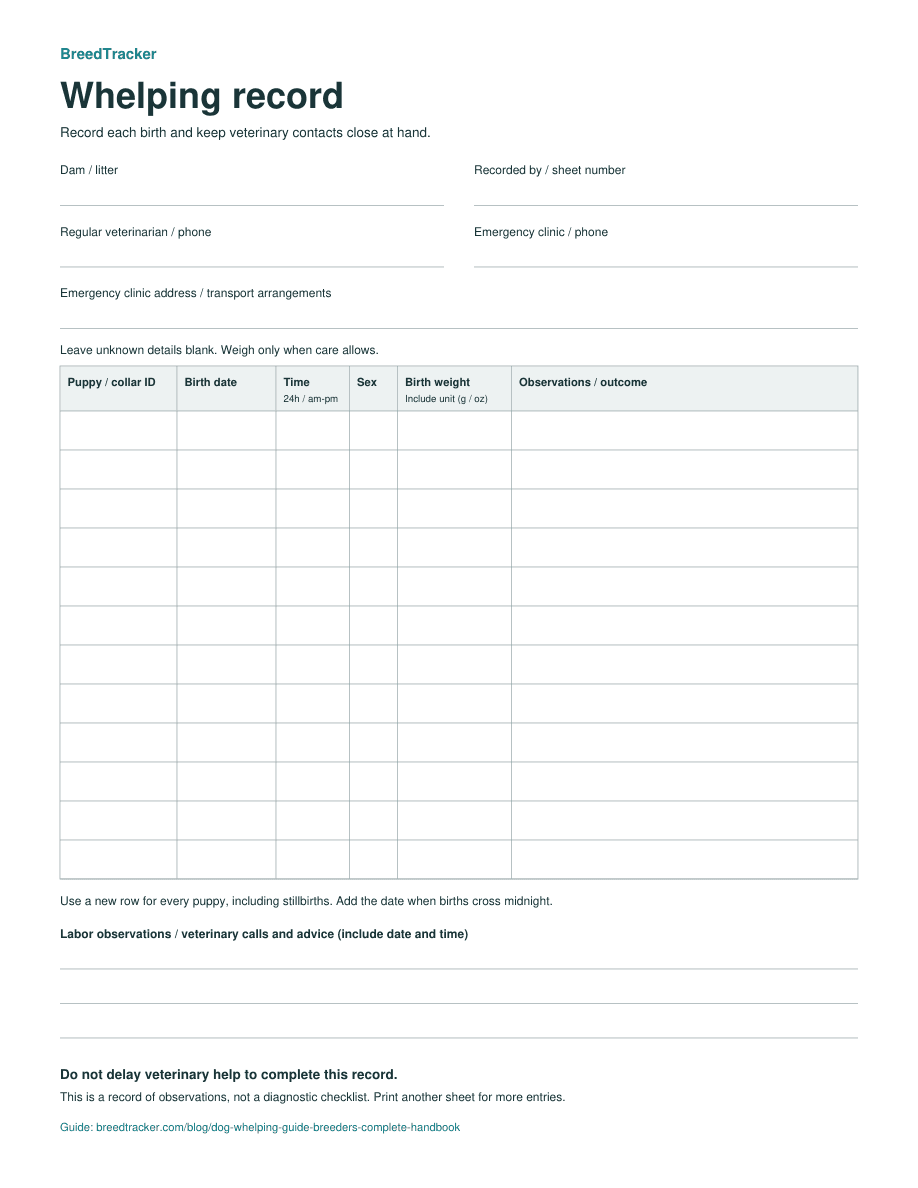
During and after whelping, document:
- Time of each birth
- Presentation (head or tail first)
- Whether placenta was delivered
- Birth weight of each puppy
- Any interventions required
- Identifying marks or collar colors
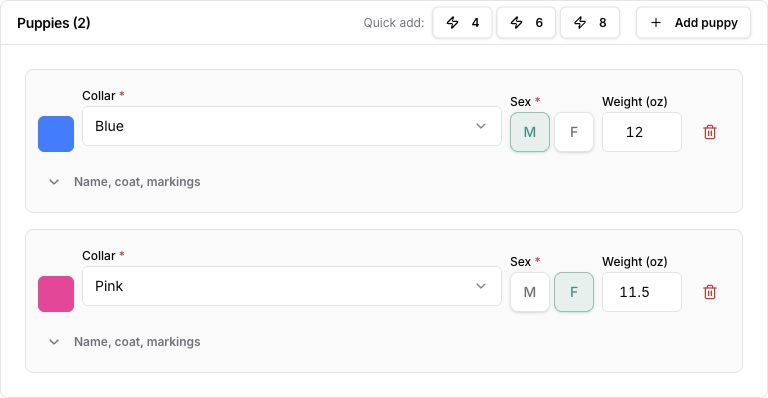
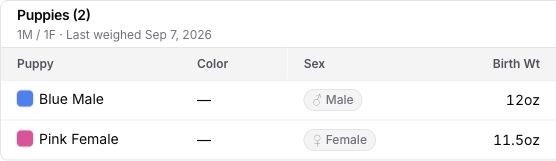
This information is invaluable for future breedings and essential if complications arise. Tools like BreedTracker allow you to log whelping events in real time, track individual puppy weights, set reminder alerts for the critical first two weeks, and generate records for puppy buyers and your veterinarian.
Frequently Asked Questions
How long is a dog in labor?
Stage 1 labor (cervical dilation, no active pushing) lasts 6-12 hours but can extend to 24-36 hours. Stage 2 (active pushing and delivery) lasts 3-12 hours depending on litter size. Total labor from first signs to last puppy can range from 6 to 24 hours. Contact your vet if Stage 1 exceeds 24 hours or if more than 4 hours pass between puppies during Stage 2.
How long between puppies is normal?
Anywhere from 30 minutes to 2 hours between puppies is considered normal. Some dams deliver several puppies quickly then rest for 1-2 hours before continuing. However, if more than 4 hours pass between puppies, or if the dam is actively straining for more than 30 minutes without producing a puppy, contact your veterinarian.
Is it normal for puppies to come out backwards?
Yes. Posterior presentation (rear feet first, body in a diving position) occurs in about 40% of canine deliveries and is completely normal. True breech (hindquarters first with legs pointing forward toward the head) is less common and may require assistance.
What does green discharge mean during whelping?
Green discharge indicates placental separation, meaning a placenta has detached from the uterine wall. This is normal if a puppy follows within 15-30 minutes. Green discharge without a puppy emerging is an emergency — the puppy is being deprived of oxygen.
Should I let my dog eat the placentas?
Eating placentas is a natural behavior that provides nutrients and helps keep the whelping area clean. However, eating too many (more than 2-3) often causes vomiting and diarrhea. You can allow the dam to eat 1-2 placentas and remove the rest.
When should I take my dog to the vet after whelping?
Schedule a post-whelping examination within 24-48 hours of the last puppy. Your vet will check that the uterus is contracting normally, ensure no puppies or placentas are retained, examine the dam for signs of infection or complications, and assess the puppies. Many breeders also request an oxytocin injection at this visit to help clear the uterus.
Key Takeaways
- Prepare early — whelping box, supplies, and emergency contacts should be ready two weeks before the due date
- Monitor temperature — a drop below 99°F predicts labor within 24 hours in 80% of dogs
- Know the stages — Stage 1 is cervical dilation (6-36 hours), Stages 2-3 are delivery and placenta passage
- Time everything — more than 30 minutes of strong contractions without a puppy, or more than 4 hours between puppies, warrants a call to your vet
- Green discharge is urgent — if you see green and no puppy follows within 15-30 minutes, call immediately
- Learn puppy resuscitation — clear airway, stimulate breathing, chest compressions at 120/minute
- High-risk breeds need planning — brachycephalic breeds, toy breeds, and giant breeds have higher dystocia rates
- Start socialization early — early neurological stimulation (ENS) begins at day 3 and structured puppy socialization protocols ramp up from week 3
- Document everything — times, weights, placentas, interventions — for this litter and future breedings
- When in doubt, call — your veterinarian wants to help, and delays cost lives
Ready to breed with confidence?
BreedTracker helps you track heat cycles, interpret progesterone results, and determine the perfect breeding window for your dogs.
Free forever · Up to 4 litters/year · No credit card required
Related Articles
Newborn Puppy Weight Chart: A Breeder's Guide to Healthy Litters
Complete newborn puppy weight chart by breed size with daily tracking protocols, fading puppy syndrome warning signs, and intervention guides for breeders.
Read moreDog Breeding Health Testing: OFA, CHIC & DNA Guide
Guide to health testing for breeders: OFA evaluations, PennHIP, CHIC certification, DNA panels, breed-specific requirements, costs, and interpreting results.
Read more