Newborn Puppy Weight Chart: Printable Log for Breeders
Download a free newborn puppy weight chart in US Letter or A4 PDF. Record measured weights and notes, and see the BreedTracker weight-recording workflow.
A newborn puppy weight chart is most useful when it contains your puppy’s actual measurements. A dated log gives you a record to compare, a way to hand over care, and something specific to share with your veterinarian.
Below, you can download a blank puppy weight log and see how to record weights in BreedTracker. The printable has no projected weights or growth targets. Its job is to preserve what you observed.
PRINTABLE WEIGHT LOG
A place for every weigh-in
Print a blank log for the weights you actually measure and notes to share with your veterinarian. The sheet contains no growth targets.
US Letter PDF · No signup required
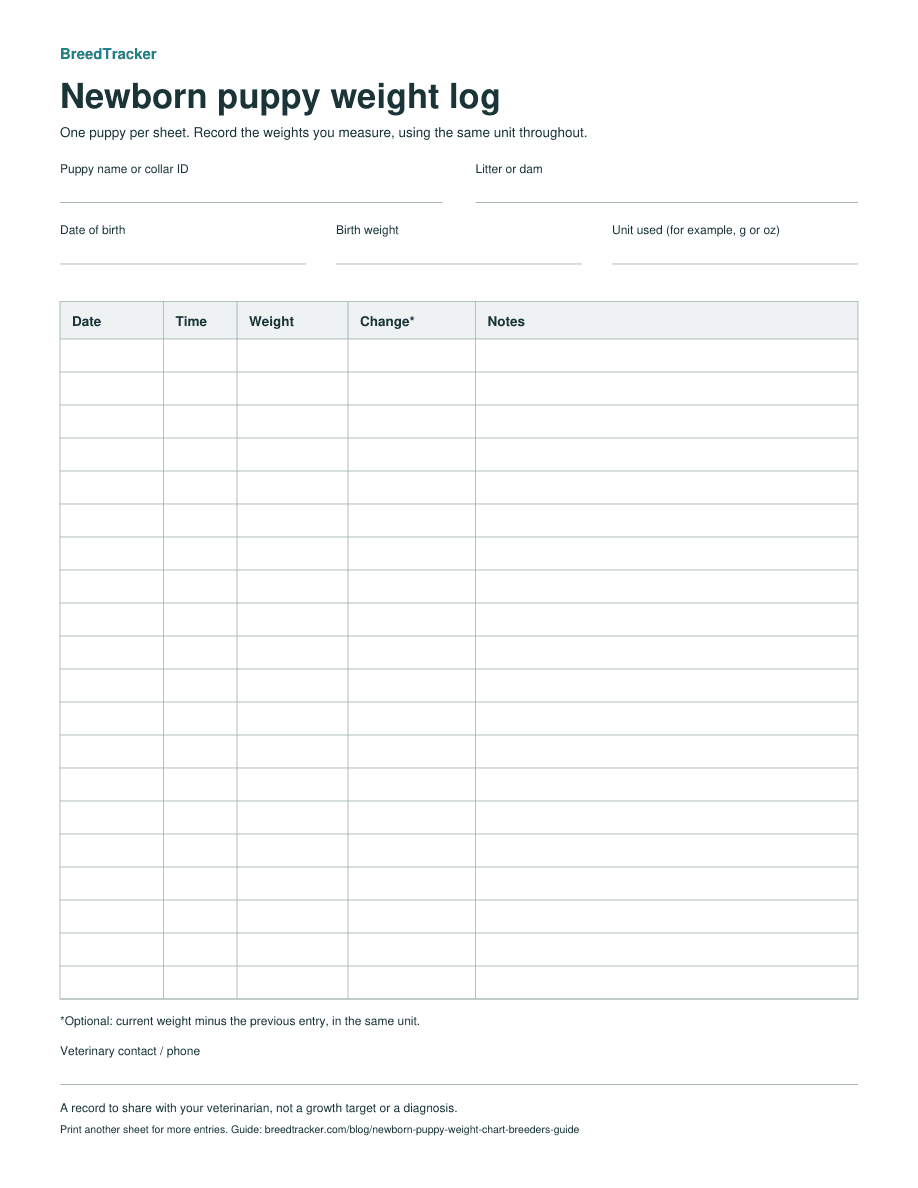
Blank log for actual weights
Newborn puppy weight gain: what the numbers mean
Birth weight and early growth can help veterinarians assess newborn puppies, but research findings need context. A study of birth weight, early growth, and survival published in 2023 (opens in a new tab) found associations between these measures and mortality in breeding-kennel records. Its statistical thresholds describe the study population; they are not feeding instructions or an individual puppy’s prognosis.
Breed and circumstances also matter. A 2026 study of Dobermann puppies (opens in a new tab) examined one breeding facility and puppies delivered by elective cesarean section. Maternal factors, litter characteristics, and puppy sex influenced the recorded weights. Applying its curves to every breed and delivery setting would go beyond that evidence.
For your records, keep the original birth weight and subsequent readings. A blank chart leaves room for the pattern your puppy actually follows.
How to use the printable puppy weight log
Use one sheet for each puppy. At the top, fill in the puppy’s name or collar ID, the litter or dam, date of birth, and recorded birth weight. Choose one weight unit for the sheet and write it in the unit field.
For each reading:
- Enter the date and actual time.
- Copy the weight displayed by your scale.
- Add the change from the previous reading if useful.
- Write a short observation or care note.
- Leave unmeasured entries blank.
The optional change column means current weight minus previous weight, using the same unit. It is a record of the difference between two measurements, not a daily growth rate when the readings are taken at different intervals.
The blank rows do not set a weighing schedule. Use as many sheets as you need, and carry the puppy’s identifier onto every page. Keep completed pages together rather than replacing the earlier record.
What belongs in the notes column?
Notes help explain the circumstances around a reading. Useful entries can include:
- Who took the measurement, especially when several people share care.
- A change of scale, or why a new sheet was started.
- Whether the reading was repeated because the display was unstable.
- An observation about nursing or behavior.
- When you contacted your veterinarian and the advice you received.
Keep observations separate from interpretations. “Did not see this puppy nurse during this check” describes what you observed. It does not establish a diagnosis or tell the next person which treatment to give.
If a measurement seems mistaken, preserve the original entry and label the repeat or correction. Do not quietly replace an unexpected number with an estimate. If a reading was missed, a blank with a note is more useful than a guessed weight.
Build a consistent recording routine
Merck Veterinary Manual’s neonatal guidance (opens in a new tab) recommends daily weight records during the first two weeks. Agree any closer monitoring with your veterinarian, and record the actual time even when it differs from your usual routine.
Consistency also makes the record easier to follow. For example, the owners participating in a 2026 neonatal growth study (opens in a new tab) weighed puppies at a consistent time each day. That was the study’s measurement method, not proof that one particular time of day is best.
Use a scale suitable for the puppy’s size and follow its instructions, including how to account for any weighing container. If you change weight units, start a new sheet and label the unit. Do not subtract readings in different units. A switch between grams and ounces should never look like a sudden change in the puppy’s weight.
When someone else takes over, leave the current sheet or digital record where they can find it. Make the next planned check and any veterinary instructions clear.
Interpret the trend with your veterinarian
Look at the sequence of measurements, their timing, and the accompanying notes. Comparing only the newest value with a generic breed-size table leaves out information that may matter for that puppy.
Early weight changes are not a simple pass-or-fail test. In a prospective breeder study published in 2023 (opens in a new tab), many puppies with early weight loss survived to weaning, and growth rate was not significantly associated with mortality in that study. The authors also discussed limitations, including few deaths after the first day. This does not establish that weight loss is harmless.
Your veterinarian can consider the puppy, the dam, and the history together. Merck’s guidance on reproduction and nursing (opens in a new tab) notes that a dam suspected of inadequate milk production needs examination for possible underlying problems. A weight change alone cannot determine an appropriate feeding method or amount.
Bring the whole log to that conversation, including missed readings and any care already provided. Ask what changes your veterinarian wants reported and how they want the puppy monitored afterward.
When to contact your veterinarian
Contact your veterinarian promptly about weight loss, a stopped or declining growth trend, weakness, or difficulty nursing. Breathing difficulty or an unresponsive puppy warrants emergency veterinary help; do not wait for the next weigh-in. Merck’s neonatal-care guidance (opens in a new tab) describes reduced weight gain, failure to suckle, and other clinical signs among concerns requiring assessment.
Have the puppy’s identifier, birth details, recent readings, and current observations ready. Keep your veterinary practice and out-of-hours contact numbers with the log.
Record puppy weights in BreedTracker
Paper can be convenient beside the litter. If you also use BreedTracker, enter the actual measurements against the correct puppy and check the dates and units against your written record.
The demonstration below uses sample records in the real application. It shows the recording workflow; the displayed weights are examples, not recommended targets.
RECORDS IN BREEDTRACKER
Keep the weigh-ins with the litter
Enter weights for the puppies in a litter, then review each puppy's dated weight history as you add records.
Synthetic example. These screenshots use invented records to show the workflow.
Record the litter's weights
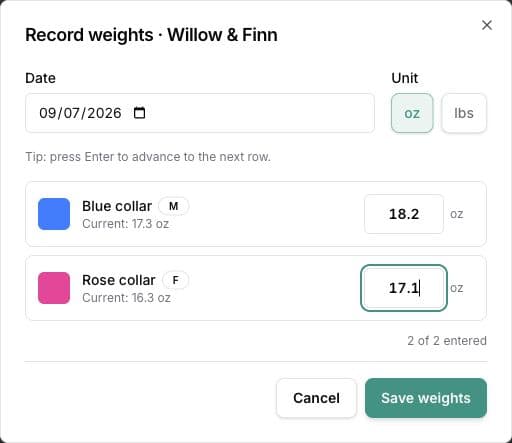
Synthetic example · Two puppies' weights, entered in ounces
Review a puppy's previous weigh-ins
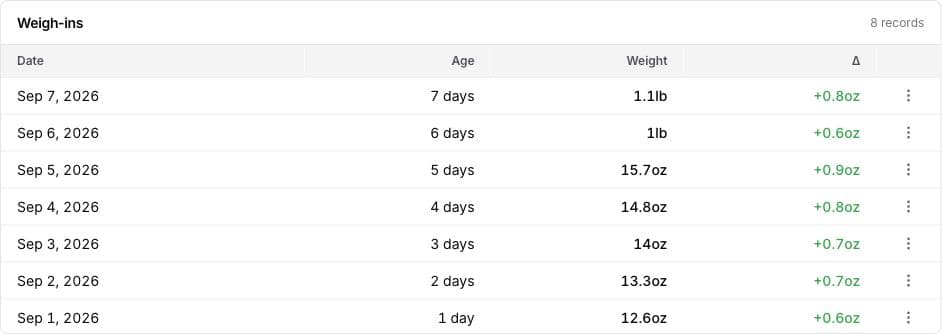
Synthetic example · A puppy's weight history
The printable log is available above without an account.
Choose where the complete record will live so that everyone helping with the litter knows which copy is current. If you transfer measurements from paper, check each entry before setting the sheet aside. Keep the original page when it contains observations that were not transferred.
Frequently asked questions
How much should a newborn puppy weigh?
This log does not assign a target birth weight. Research examining birth weight and early growth (opens in a new tab) considers the puppy’s context and subsequent measurements. Record the weight you observe and discuss expectations for your litter with your veterinarian.
Can newborn puppies lose weight after birth?
Early loss appears in published research, including the prospective breeder study (opens in a new tab). That observation does not tell you whether a particular puppy is well. Contact your veterinarian about a loss or other concerns using the guidance above.
Should every puppy follow the same growth curve?
Do not use the example weights in an article or app demonstration as targets. The Dobermann research (opens in a new tab) illustrates how a study’s breed and delivery setting limit where its findings apply. Keep each puppy’s own record.
Can I use ounces instead of grams?
The blank log has a unit field. Use one unit consistently on a sheet; start a new sheet if you switch units. When copying a reading into an app, confirm that the selected unit matches the scale and your written record.
Do I need an app to use this log?
No. You can download the printable log and write on it. The BreedTracker demonstration shows an optional way to keep the measurements with your puppy records.
Evidence and update note
Sources checked September 7, 2026. BreedTracker prepared this page as a recordkeeping resource; it has not undergone veterinary review. Linked studies describe their own populations and methods.
This update replaces projected weight tables and general intervention thresholds with a blank log, sourced context, and a recording demonstration. Veterinary assessment and an individualized care plan remain separate from the recordkeeping tools.
Free tools for this topic
Related Articles
Dog Whelping Guide: Preparation and Birth Records
Prepare for whelping, download a printable birth record, learn when to contact your veterinarian, and see how to record a litter in BreedTracker.
Read morePuppy Socialization: Week-by-Week Breeder Protocol
Week-by-week puppy socialization protocol covering ENS, Early Scent Introduction, Puppy Culture, the Rule of Sevens, and temperament testing for breeders.
Read more