Back to all articles
Breeding

Complete Guide to Dog Heat Cycle Management for Breeders

Master the canine estrous cycle with progesterone testing protocols, breeding timing, and management of split heats, silent heats, and abnormalities.

BreedTracker TeamDecember 6, 202522 min read

A German Shepherd bitch who should have been bred yesterday. A Cavalier showing flagging behavior but whose progesterone is still baseline. A maiden bitch with a "silent heat" that the breeder missed entirely.

The difference between a successful breeding and an empty ultrasound often comes down to 24–48 hours. Miss the window, and you wait another six months. Miss it twice, and you have lost a year of your breeding program.

This guide walks you through the complete estrous cycle — the science behind each stage, the physical signs to watch, the tests that remove guesswork, and the protocols that professional breeders use to hit that narrow fertile window every time. Whether you are breeding your first litter or your fiftieth, understanding heat cycle management is the foundation of reproductive success.

The Four Stages of the Canine Estrous Cycle

Unlike humans, dogs are monoestrous — they typically cycle once every 5 to 11 months, with most breeds averaging two heat cycles per year. The complete estrous cycle consists of four distinct phases, each with specific hormonal signatures and physical signs.

Proestrus: The Preparation Phase

Duration: 6–11 days (average 9 days)

Proestrus is the opening act. The ovaries begin producing estrogen, which causes the vulva to swell — sometimes dramatically, increasing to 3–4 times its normal size — and triggers the bloody vaginal discharge that most breeders recognize as "the heat starting."

Physical signs during proestrus:

  • Swollen vulva (progressive, most pronounced near the end)
  • Bloody vaginal discharge (bright or dark red)
  • Increased urination (scent marking to attract males)
  • Restlessness and behavioral changes
  • Attracting male dogs but rejecting mounting attempts

The key behavioral marker: a proestrus bitch will allow males to investigate but will sit down, tuck her tail, or snap when they attempt to mount. She is advertising availability but not yet receptive.

Hormone activity: Estrogen rises steadily during proestrus, reaching peak levels 1–2 days before estrus begins. This estrogen surge triggers the luteinizing hormone (LH) surge that initiates ovulation.

Estrus: The Fertile Window

Duration: 3–21 days (average 9 days)

Estrus is the main event — the only time during the cycle when the bitch is fertile and will stand for breeding. It begins with the LH surge and ends when progesterone levels indicate the fertile window has closed.

Physical signs during estrus:

  • Discharge lightens from red to pink, straw-colored, or clear
  • Vulva softens (feels less turgid than during proestrus)
  • Flagging: the bitch moves her tail to the side when touched near the base
  • Standing heat: actively presenting to males and accepting mounting
  • May become more affectionate or clingy with handlers

The discharge color change is one of the most reliable visual indicators. As estrogen drops and progesterone rises, the bloody discharge transitions to a lighter, more watery appearance. This is often described as the discharge becoming "cleaner" — though some bitches have minimal visible discharge throughout their cycle.

Hormone activity: The LH surge lasts approximately 24–48 hours and triggers ovulation about 2 days later. Progesterone begins rising at the time of the LH surge and continues increasing through estrus and into diestrus.

The critical timing detail: Canine oocytes (eggs) are not immediately fertilizable after ovulation. They require an additional 2–3 days to mature before they can be fertilized. This is why the optimal breeding window is 4–6 days after the LH surge — not immediately after ovulation.

Diestrus: The Post-Breeding Phase

Duration: 60–90 days

Diestrus begins when the bitch stops accepting the male and ends when progesterone returns to baseline. Whether or not she is pregnant, her body behaves as if she is — progesterone remains elevated for 60–90 days.

Physical signs during diestrus:

  • Rejection of male advances
  • Discharge ceases or becomes minimal
  • Vulva returns to normal size
  • Possible mammary development (pregnant or not)
  • Behavioral return to normal baseline

Hormone activity: Progesterone peaks 2–3 weeks after ovulation at approximately 15–90 ng/ml, then gradually declines over the remainder of diestrus. If the bitch is pregnant, progesterone remains elevated until 24–48 hours before whelping, when it drops sharply below 2 ng/ml — the signal that triggers labor.

Diestrus is identical in pregnant and non-pregnant bitches until the final weeks, which is why false pregnancy is so common in dogs. The hormonal environment supports pregnancy whether conception occurred or not.

Anestrus: The Resting Phase

Duration: 60–200 days (average 4–5 months)

Anestrus is reproductive dormancy. The ovaries are quiet, and the uterus is recovering and regenerating from the previous cycle. There are no external signs of reproductive activity.

What happens during anestrus:

  • Uterine involution (return to non-pregnant state)
  • Hormonal baseline (minimal estrogen and progesterone)
  • Ovarian follicle development begins in late anestrus

This phase ends when the hypothalamus signals the pituitary to release follicle-stimulating hormone (FSH), which initiates follicular development and the next proestrus.

The Complete Estrous Cycle Timeline

Here is the full cycle in summary form:

StageDurationKey SignFertile?Dominant Hormone
Proestrus6–11 daysBloody discharge, swollen vulvaNoEstrogen (rising)
Estrus3–21 daysStanding heat, discharge lightensYesProgesterone (rising)
Diestrus60–90 daysRejects males, quietNoProgesterone (elevated)
Anestrus60–200 daysNo signsNoBaseline

The total cycle length varies by breed. Basenji and Tibetan Mastiffs often cycle only once per year. German Shepherds typically cycle every 4–5 months. Most breeds fall somewhere in between at 6–7 month intervals.

Why Traditional Breeding Timing Fails

For generations, breeders were taught to count days: "Breed on days 10, 12, and 14 after the first sign of blood." This advice produces litters — sometimes — but it fails at least 30% of the time because it ignores the enormous variation between individual bitches.

The problem with day counting:

  • Proestrus length varies from 3 to 21 days across individuals
  • The first visible discharge may not coincide with actual cycle day one
  • Some bitches ovulate on day 8, others on day 25
  • Silent heats, split heats, and irregular cycles are common

Day counting is betting on averages. Progesterone testing is betting on certainty.

Progesterone Testing: The Gold Standard

Progesterone testing removes guesswork from breeding timing. The progesterone level tells you exactly where a bitch is in her cycle, when she will ovulate, and when she should be bred.

The Critical Progesterone Levels

Progesterone LevelWhat It MeansAction
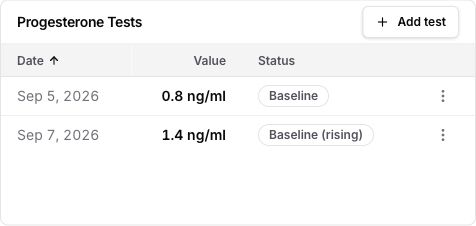
< 1.0 ng/mlBaseline — not yet approaching ovulationRetest in 2–3 days
2.0–2.5 ng/mlLH surge occurring (Day 0)Ovulation in ~48 hours
5.0–8.0 ng/mlOvulation occurringEggs maturing, breeding imminent
10–15+ ng/mlEggs mature and fertilizableOptimal breeding window
40–50+ ng/mlPeak progesterone, post-breedingBreeding window closing

The LH surge (progesterone rising above 2.0 ng/ml) is "Day 0" — the reference point for all breeding timing. Ovulation occurs approximately 48 hours after the LH surge. Eggs mature and become fertilizable 2–3 days after ovulation.

Optimal Breeding Timing by Method

The ideal breeding day depends on how you are breeding:

Breeding MethodOptimal TimingProgesterone Reference
Natural breedingDays 3–5 after LH surge72 hours after 2.5 ng/ml
Fresh chilled semenDays 4–5 after LH surge48 hours after 5 ng/ml
Frozen semenDays 5–6 after LH surge72 hours after 5 ng/ml

Frozen semen has a shorter lifespan after thawing (12–24 hours) compared to fresh semen (5–7 days), which is why timing must be more precise.

Progesterone Testing Protocol

When to start testing: Begin testing 5–6 days after the first sign of proestrus (bloody discharge and/or vulvar swelling). This establishes a baseline.

Testing frequency:

  • Every 2–3 days while progesterone is below 2.0 ng/ml
  • Every 24–48 hours once progesterone reaches 1.5 ng/ml
  • Daily once you are approaching the breeding window

Testing methods:

  • In-clinic quantitative tests (IDEXX Catalyst, Mini VIDAS) — most accurate, results in minutes
  • Reference laboratory tests — gold standard accuracy, but 24–48 hour turnaround
  • Semi-quantitative in-house tests — less accurate, useful for screening but should be confirmed with quantitative testing for breeding decisions

The cost of progesterone testing ($40–100 per test depending on your location and clinic) is trivial compared to the cost of a missed breeding, a flight for a stud dog, or shipping frozen semen internationally.

Vaginal Cytology: The Supporting Player

Vaginal cytology examines cells from the vaginal wall under a microscope. As estrogen rises during proestrus, the vaginal epithelium thickens and the cells become increasingly "cornified" (keratinized, flattened, and angular).

Cytology stages:

Cycle StageCell TypesCornification %
Early proestrusParabasal, intermediate cells; red blood cells< 50%
Late proestrusSuperficial cells increasing50–80%
EstrusSuperficial and anuclear cells; debris80–100%
DiestrusIntermediate cells, white blood cells return< 20%

The limitation: Vaginal cytology tells you that estrus is occurring, but it cannot pinpoint ovulation. A bitch can be at 100% cornification for 10+ days. Cytology is useful for confirming you are in the fertile phase but should not be used alone for breeding timing. The gold standard approach: use cytology to confirm entry into estrus, then switch to progesterone testing to pinpoint ovulation.

Recognizing Physical Signs of Readiness

While testing provides precision, experienced breeders also read their bitches. Physical signs complement (but do not replace) diagnostic testing.

Discharge Color Progression

StageDischarge AppearanceWhat It Indicates
Early proestrusBright red, heavyEstrogen rising, not yet receptive
Late proestrusDark red, moderateApproaching estrus
Early estrusPink, lighterLH surge imminent or occurring
Peak estrusStraw-colored or clear, wateryOptimal breeding window

The classic teaching: "Breed when the discharge goes from red to straw-colored." This is a useful rule of thumb, but some bitches maintain bloody discharge throughout estrus, while others have minimal visible discharge. Trust the testing, use the color as a supporting data point.

Vulvar Changes

The vulva swells progressively during proestrus, reaching maximum turgidity around the time of the LH surge. A key physical sign of estrus: the vulva softens and appears slightly wrinkled rather than tight and shiny. This "softening" often coincides with the onset of standing heat.

Behavioral Markers

Flagging: When you scratch or press at the base of the tail, a receptive bitch will swing her tail to one side, presenting her vulva. This reflex indicates standing heat and willingness to breed.

Presenting: An estrus bitch may actively back into male dogs (or humans, or furniture) and hold a breeding posture.

Proceptive behavior: Increased affection, following, vocalizing, and soliciting attention.

These behaviors are driven by hormones, but individual bitches vary enormously. Maiden bitches may be fearful despite being in standing heat. Some dominant bitches never show classic submission postures. Always confirm with testing.

Abnormal Heat Cycles Every Breeder Should Know

Not all cycles follow the textbook pattern. Knowing how to recognize and manage abnormal cycles is essential.

Split Heat

What it is: The bitch begins showing proestrus signs (discharge, swelling), then the signs disappear without ovulation occurring. Days to weeks later, she begins again and completes a normal estrus with ovulation.

Why it happens: Most common in young bitches during their first or second cycle, when the hormonal cascade is not yet fully coordinated. Some bitches have split heats with every cycle.

Management: If breeding is the goal, track the "false start" but do not attempt to breed. Wait for the second phase, confirm with progesterone testing that ovulation is actually occurring, and breed during the true fertile window. Split heats can be confusing — testing removes the confusion.

Silent Heat

What it is: The bitch ovulates and is fertile, but shows minimal or no external signs — no swelling, no discharge, no behavioral changes.

Why it happens: Low estrogen levels or anatomical variations. Some bitches clean themselves so fastidiously that discharge is never observed.

Management: Silent heats are the reason experienced breeders do routine progesterone screening on bitches they plan to breed. If you do not see signs but suspect she may be cycling (male dogs showing interest, subtle behavioral changes), run a progesterone test. Silent heats are frequently missed, leading to "infertile" diagnoses when the bitch is actually cycling normally — just invisibly.

Prolonged Heat

What it is: Proestrus or estrus lasting significantly longer than normal (total heat period exceeding 4 weeks).

Why it happens: Ovarian cysts, hormone-producing ovarian tumors, or exogenous hormone exposure. Some bitches naturally have longer cycles without pathology.

Management: If proestrus extends beyond 21 days or estrus beyond 3 weeks without resolution into diestrus, veterinary evaluation is warranted. Ultrasound can identify ovarian abnormalities. Treatment depends on the cause.

Absent Heat (Prolonged Anestrus)

What it is: No heat cycle for longer than 10–12 months (longer than 18 months for breeds that typically cycle annually).

Why it happens: Hypothyroidism, nutritional deficiencies, chronic stress, silent heats that were missed, or primary ovarian failure.

Management: Rule out silent heats first with progesterone testing. Check thyroid function. Evaluate body condition and nutrition. Primary ovarian failure (no response to hormonal stimulation) is rare but possible, particularly in bitches with autoimmune conditions or prior chemotherapy.

Short Interestrous Interval

What it is: Cycles occurring more frequently than every 4 months.

Why it happens: Often normal variation, particularly in smaller breeds. Can indicate ovarian pathology if accompanied by other abnormalities.

Management: Short cycles alone are not necessarily problematic if ovulation and fertility are normal. However, very short cycles (every 2–3 months) may not allow adequate uterine recovery and can be associated with reduced fertility.

Tracking Heat Cycles: Building Your Breeding Data

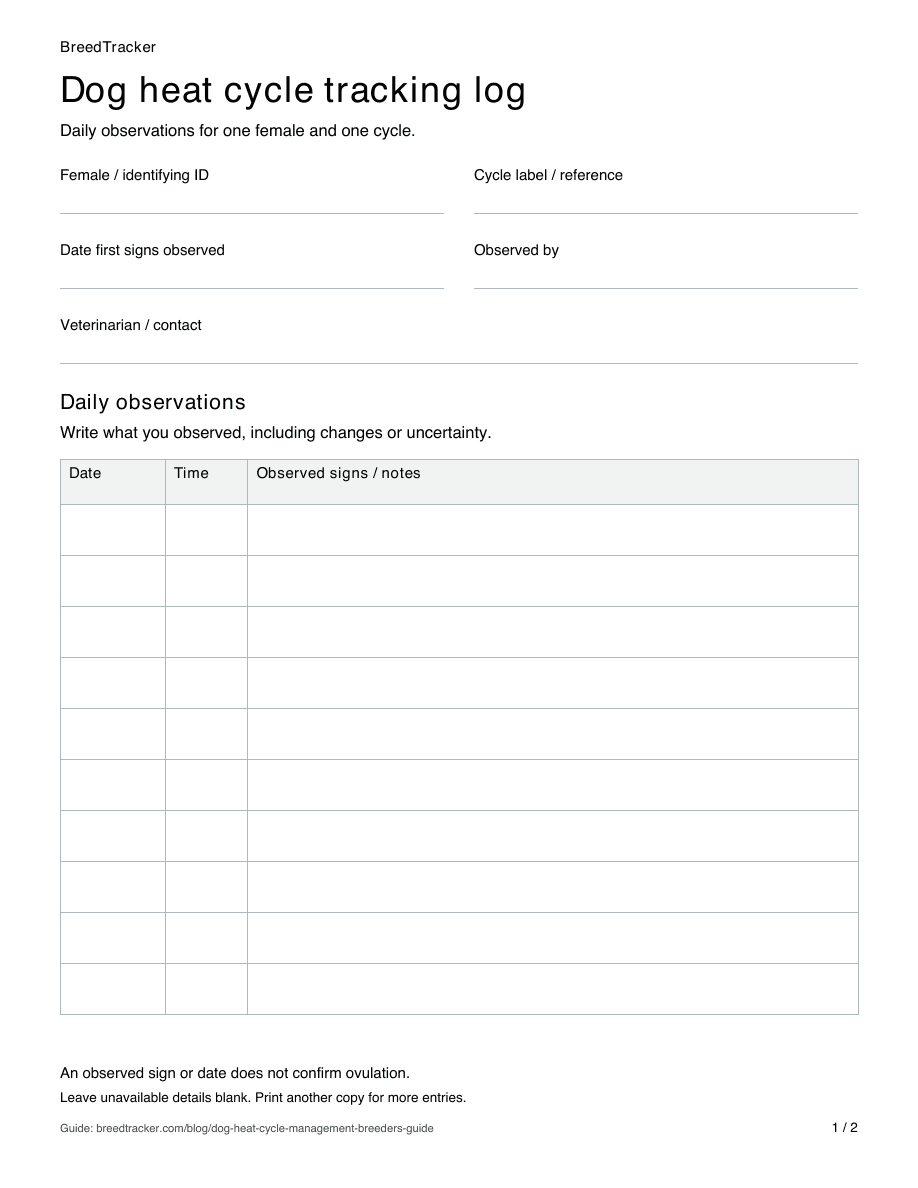
Consistent tracking transforms guesswork into prediction. After several recorded cycles, you will know your bitch's pattern — her typical cycle length, her usual proestrus duration, and when she tends to ovulate.

What to Track

For each heat cycle, record:

  • First day of discharge (Day 1)
  • Discharge color changes (with dates)
  • Vulvar swelling (onset, peak, softening)
  • Behavioral changes (attracting males, flagging, standing)
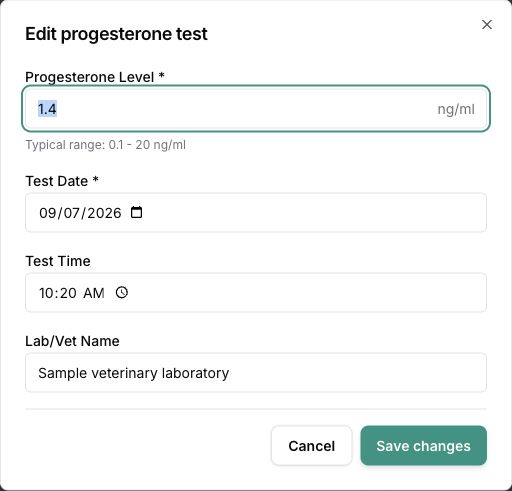
  • Progesterone test results (date, level, lab)
  • Vaginal cytology results (if performed)
  • Breeding dates (natural or AI, semen type)
  • Any abnormalities (split heat, irregular discharge, etc.)

Why Historical Data Matters

A bitch who consistently ovulates on Day 12 will likely do so again. A bitch with a 14-day proestrus needs later progesterone testing than one with a 6-day proestrus. Historical data allows you to start testing at the right time, reducing the number of tests needed and improving your chances of catching the optimal breeding window.

This is exactly the kind of longitudinal tracking that breeding software is designed for. Tools like BreedTracker can store cycle history for each bitch, automatically calculate average intervals, and alert you when an expected heat is approaching — turning scattered notes into actionable breeding intelligence.

Breeding Frequency and Uterine Health

How often can you breed a bitch safely? This question generates more debate among breeders than almost any other topic.

The Traditional View

Conventional wisdom said: skip at least one heat cycle between breedings to allow the uterus to rest. Many kennel clubs and registries still recommend this approach.

The Modern Veterinary Perspective

Reproductive veterinarians (theriogenologists) increasingly recommend breeding on consecutive cycles when the bitch is healthy and young, then retiring her earlier rather than breeding sporadically over many years.

The reasoning: each heat cycle exposes the uterus to progesterone, which causes endometrial thickening. Over time, repeated cycling without pregnancy leads to cystic endometrial hyperplasia (CEH) — a condition that predisposes to pyometra and reduces fertility. A bitch bred back-to-back for 3–4 litters and then spayed may have better lifetime uterine health than one bred every other cycle for 8 years.

Guidelines for Breeding Frequency

FactorRecommendation
Age at first breedingAfter full maturity (18–24 months for most breeds, second or third heat)
Consecutive breedings2–3 back-to-back litters acceptable if bitch is in excellent condition
Evaluating readinessBody condition, recovery from previous litter, overall health
Maximum litters4–6 lifetime (varies by breed, individual health)
Retirement age5–7 years for most breeds

The most important factor is not how many heats you skip, but how well the bitch recovers between litters. A bitch who is thin, depleted, or slow to regain condition should not be bred on the next cycle. A bitch who bounces back quickly and is in excellent health may be bred again.

Registry Rules

Be aware of kennel club limitations:

  • AKC: No puppies registered from dams younger than 8 months or older than 12 years
  • UKC: Limits registration to 4–5 litters per dam
  • KC (UK): No more than 4 litters per dam; no registration if dam over 8 years at whelping

These are registration limits, not biological limits, but they reflect responsible breeding practices.

Pyometra: The Hidden Danger of Unspayed Bitches

Pyometra is a life-threatening uterine infection that affects approximately 25% of unspayed bitches by age 10. Every breeder must understand this risk.

How Pyometra Develops

During diestrus, progesterone stimulates the uterine lining to thicken and suppresses local immune function (preparing for potential pregnancy). If bacteria enter the uterus during estrus — when the cervix is open — they find an ideal environment for growth. The result is a uterus filled with pus.

Pyometra typically develops 2–8 weeks after a heat cycle, during the diestrus phase.

Risk Factors

  • Increasing age (each cycle without pregnancy increases risk)
  • Cystic endometrial hyperplasia (CEH)
  • Hormone treatments (estrogen, progestins)
  • Never having been pregnant

Warning Signs

Open pyometra (cervix open, pus draining):

  • Purulent or bloody vaginal discharge (cream, yellow, green, or brown)
  • Lethargy, decreased appetite
  • Increased thirst and urination
  • Fever (or subnormal temperature in septic shock)

Closed pyometra (cervix closed, pus trapped):

  • Distended abdomen
  • Severe lethargy, vomiting
  • May collapse suddenly
  • No visible discharge (which makes it more dangerous)

Closed pyometra is a surgical emergency. Without treatment, the uterus can rupture, causing peritonitis and death.

Prevention

The only complete prevention is spaying. For breeding bitches:

  • Breed young, complete your breeding program, then spay
  • Avoid unnecessary hormone treatments
  • Monitor carefully during diestrus after any heat cycle
  • Do not leave a bitch intact indefinitely "in case" you want to breed her someday

Treatment

Emergency ovariohysterectomy (spay) is the definitive treatment. Medical management with prostaglandins is possible in valuable breeding bitches with open pyometra, but carries risks and does not eliminate future recurrence.

Building a Heat Cycle Management Protocol

Here is a complete protocol for managing your bitch's heat cycle from first signs through breeding:

Phase 1: Pre-Heat Preparation

30 days before expected heat:

  • Confirm health check and current vaccinations (see our health testing requirements guide for the complete testing protocol)
  • Verify the stud dog is available and tested (see our stud dog selection guide for evaluation criteria)
  • Arrange progesterone testing with your veterinarian
  • Review historical cycle data

Phase 2: Proestrus Monitoring (Days 1–9 typically)

Day 1: First sign of bloody discharge or vulvar swelling

  • Begin daily tracking (discharge color, vulvar changes, behavior)
  • Schedule first progesterone test for Day 5–6

Days 5–6: First progesterone test

  • If < 1.0 ng/ml: retest in 2–3 days
  • If 1.0–1.5 ng/ml: retest in 1–2 days
  • If ≥ 2.0 ng/ml: LH surge — see Phase 3

Phase 3: Estrus and Breeding Window (Days 10–15 typically)

LH surge confirmed (progesterone 2.0–2.5 ng/ml):

  • This is Day 0 of your breeding countdown
  • Ovulation occurs approximately Day 2
  • Eggs mature Days 4–5
  • Schedule breeding per your method (natural: Days 3–5, fresh chilled: Days 4–5, frozen: Days 5–6)

Confirm with follow-up progesterone:

  • Level of 5.0+ ng/ml confirms ovulation has occurred
  • Level of 10.0+ ng/ml confirms eggs are mature and fertilizable

Breed:

  • Two breedings 24–48 hours apart is standard
  • Document dates, times, and method

Phase 4: Post-Breeding

Ultrasound for pregnancy confirmation: 25–30 days post-breeding

Continue progesterone monitoring (optional): Some breeders monitor progesterone through pregnancy, as a drop below 2 ng/ml can signal impending abortion or, at term, imminent labor.

Key Takeaways

  • The fertile window is narrow — 4–6 days after the LH surge. Missing it by 48 hours can mean a missed pregnancy.
  • Progesterone testing is the gold standard — day counting and physical signs are helpful but not precise enough for optimal breeding timing.
  • Learn your bitch's individual pattern — historical data predicts future cycles better than breed averages.
  • Abnormal cycles are common — split heats, silent heats, and prolonged cycles require diagnostic work, not guesswork.
  • Track everything — dates, discharge, behavior, test results. Comprehensive records improve outcomes with each breeding.
  • Consider uterine health long-term — breeding young and completing your program efficiently may be healthier than spreading litters over many years.
  • Know the pyometra warning signs — every intact bitch is at risk, and this condition is a medical emergency.

Frequently Asked Questions

How do I know when my dog is ready to breed?

The most reliable indicator is progesterone level. When progesterone reaches 10–15 ng/ml (approximately 4–5 days after the initial rise above 2 ng/ml), eggs are mature and fertilizable. Physical signs like discharge lightening to straw color, vulvar softening, and standing heat (flagging) support this timing but should not be used alone.

How many times should I breed my dog during her heat?

Two breedings 24–48 hours apart during the optimal window is standard practice. With progesterone-guided timing, even a single well-timed breeding can achieve conception. Multiple matings spread over many days are less effective than two properly timed breedings.

What is the best age to breed a female dog for the first time?

Most theriogenologists recommend breeding after physical and mental maturity — typically the second or third heat cycle, which is usually 18–24 months of age for most breeds. Breeding on the first heat is not recommended as the bitch is still developing.

How long after bleeding stops can I breed my dog?

The transition from bloody to lighter discharge often corresponds with early estrus, but the optimal breeding window is determined by ovulation, not discharge color. Some bitches bleed throughout estrus. The answer is to test progesterone rather than count days after bleeding changes.

Why does my dog keep missing when we try to breed?

The most common cause of "missed" breedings is timing error — breeding too early or too late relative to ovulation. Other causes include male subfertility, female reproductive pathology (cysts, infections, anatomical abnormalities), or silent/split heats. Start with progesterone testing to confirm timing is correct, then investigate other factors if properly timed breedings continue to fail.

Can I breed my dog on back-to-back heat cycles?

Yes, when the bitch is healthy, young, and in excellent body condition. Modern reproductive veterinarians often recommend completing 2–3 litters in succession and retiring the bitch earlier, rather than breeding sporadically over many years. The key is assessing individual recovery — a bitch who is thin or depleted after weaning should not be bred immediately.

BT
Written by
BreedTracker Team
Expert Breeders & Developers

Ready to breed with confidence?

BreedTracker helps you track heat cycles, interpret progesterone results, and determine the perfect breeding window for your dogs.

Free forever · Up to 4 litters/year · No credit card required

Related Articles