Find your dog’s next heat window
3 minute readFree planUpdated September 2026
BreedTracker estimates your dog’s next heat window from recorded heat start dates and breed averages. Find the date range, understand its uncertainty, and check upcoming heat reminders.
In this stage
Planning a breeding
- Record a heat cycle
- Track progesterone test results
- Log a breeding
- Find your dog’s next heat window
On this page
Why it matters
- Every breeding female gets a date range for the next season, months ahead, from the heats you already recorded.
- The estimate shows its uncertainty, so a broad window is labelled clearly.
- Recorded heats give BreedTracker cycle history to use alongside the breed average.
Find your dog’s next heat window
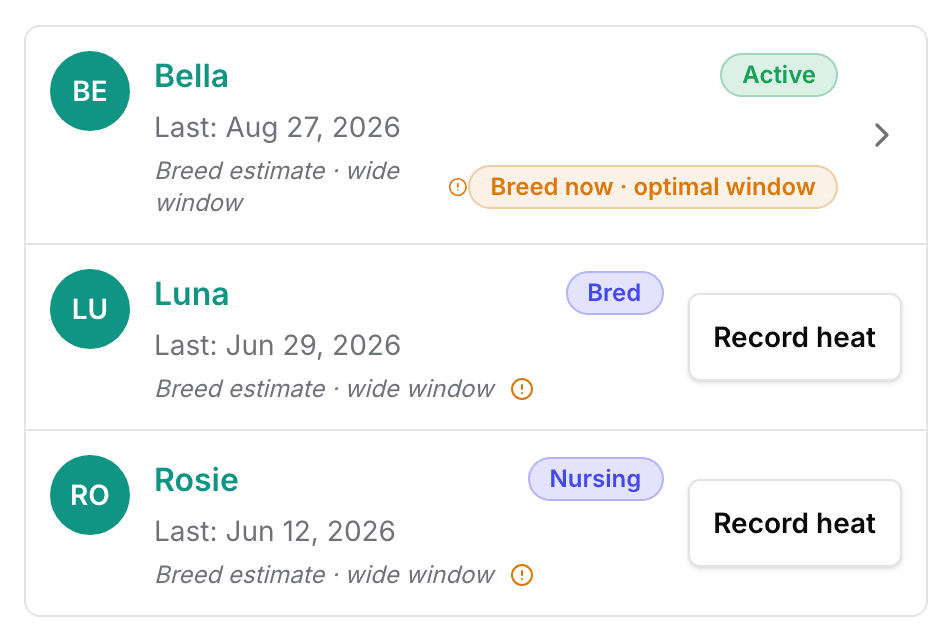
Heats lists every breeding female with a Next Heat (window) column, a date range and how wide it is. With one recorded heat or none, the column reads Breed estimate · wide window.
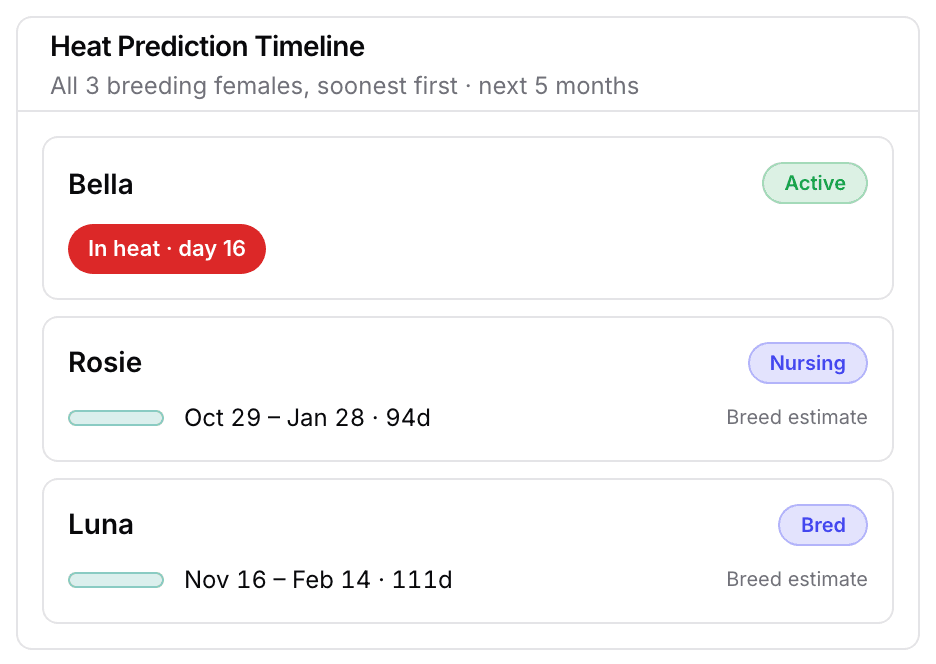
Above it, the Heat Prediction Timeline draws the same windows on one line, paler for a breed estimate.
The female’s own page shows Likely Heat Window under Upcoming Events, and the dashboard's board draws proj. heat.
How BreedTracker estimates the next heat
With one recorded heat, the estimate starts from the breed average and that heat’s date. It shows Breed estimate · wide window. With more recorded heats, BreedTracker uses the gaps between them alongside breed averages.
The date range reflects uncertainty and can change as records or time change. More records do not guarantee a narrower window. A warning triangle beside a row explains uncertainty in the estimate.
Understand what changes the heat estimate
- Record each heat’s actual start date. These dates provide the cycle history used by the estimate.
- Progesterone results sharpen this heat's breeding window, not the next one. See Track progesterone test results.
- The Heats-page estimate also considers breed information, the dog’s age, and time since the last recorded heat.
- Keep heat dates accurate. Add missing heats and remove duplicate entries. See Record a heat cycle.
Check the upcoming heat reminder
When a predicted heat is within seven days, Heats shows {Name} · heat predicted in {n} days at the top.
Next
Did this answer your question? If not, we would like to know what you were looking for.
Email support