How to Screen Puppy Buyers: A Breeder's Guide
Learn how to screen puppy buyers with application templates, red flag checklists, waitlist strategies, and placement best practices for responsible breeders.
You spent months planning this breeding. You tracked progesterone, coordinated with the stud owner, supported your dam through pregnancy, and barely slept during whelping week. Now you have eight healthy puppies on the ground — and 47 people in your inbox asking for one.
This is where the real work begins. Placing puppies in the wrong homes leads to returns, rehoming, and — in the worst cases — dogs ending up in rescue. Studies from the ASPCA estimate that roughly 3.1 million dogs enter U.S. shelters each year, and a significant percentage of surrenders cite "lifestyle mismatch" or "behavioral issues" that proper screening could have predicted. Every puppy you place is your reputation walking out the door on four legs.
The good news: a structured screening process protects your puppies, reduces buyer drama, and actually makes placement easier — not harder. This guide covers everything from building your application to managing your waitlist to handing over a go-home kit that sets new owners up for success.
Why Buyer Screening Matters More Than You Think
Bad placements don't just hurt the dog. They hurt your program.
A puppy returned at six months disrupts your entire operation. A buyer who stops vaccinating or ignores your spay/neuter contract creates health and ethical problems you'll hear about for years. A dog surrendered to rescue with your kennel name attached damages your reputation with breed clubs, other breeders, and future buyers.
Responsible screening isn't gatekeeping — it's stewardship. You're not looking for perfect people. You're looking for people who are prepared, committed, and honest about their lifestyle. The goal is to match every puppy with a home where it will thrive for its entire 10–15 year lifespan.
The best breeders treat the screening process as a two-way conversation. You're evaluating buyers, but you're also educating them — about the breed, about your program, and about what responsible ownership looks like. That education starts with your application.
Building Your Puppy Buyer Application
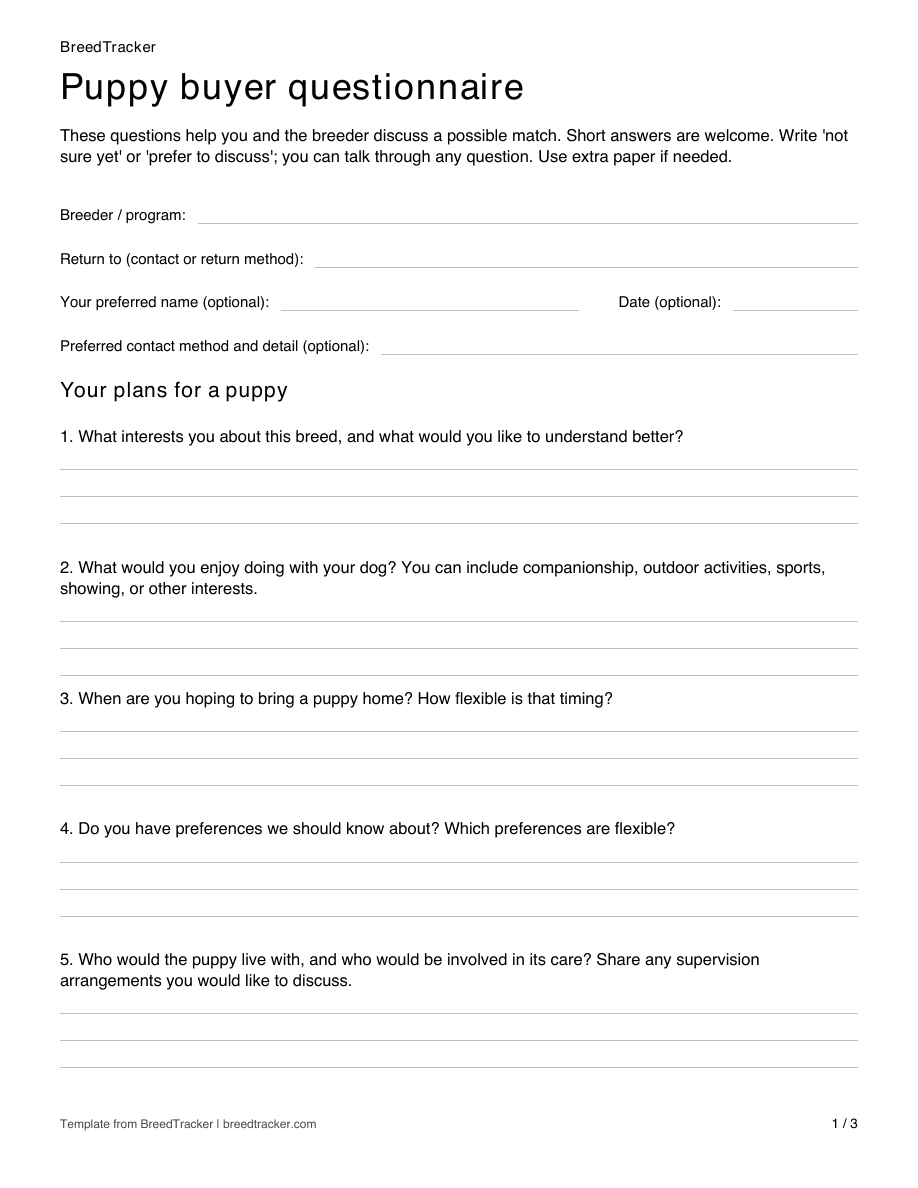
Your application is your first filter. A well-designed questionnaire accomplishes three things simultaneously: it collects the information you need, it signals your professionalism, and it naturally discourages unserious inquiries. People who won't fill out a two-page form probably aren't prepared for the commitment of raising a puppy.
Format Options
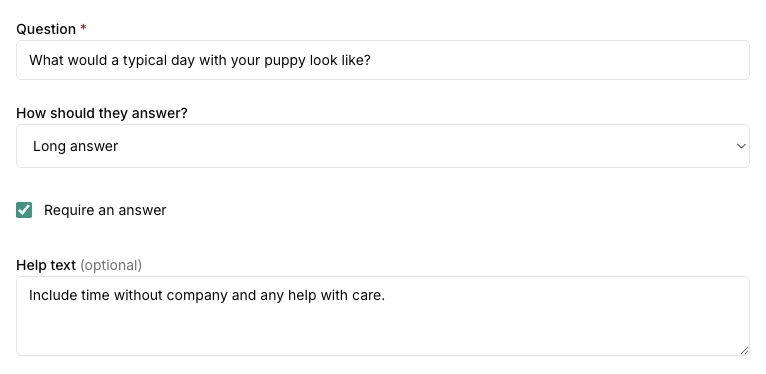
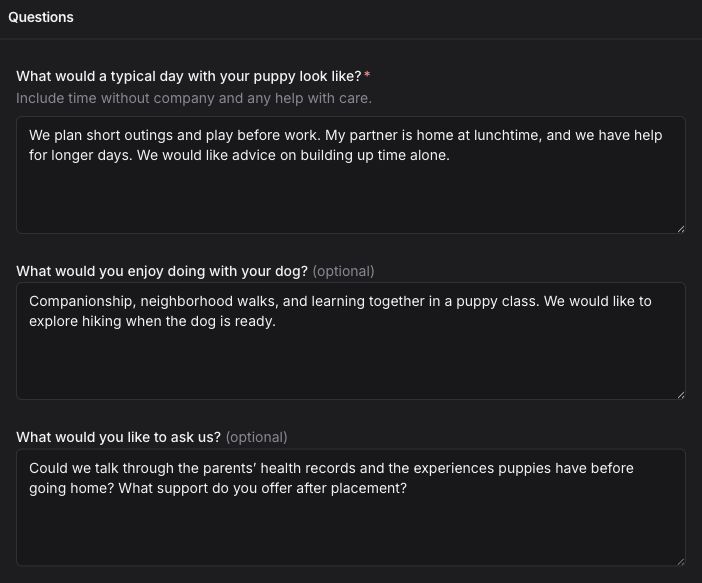
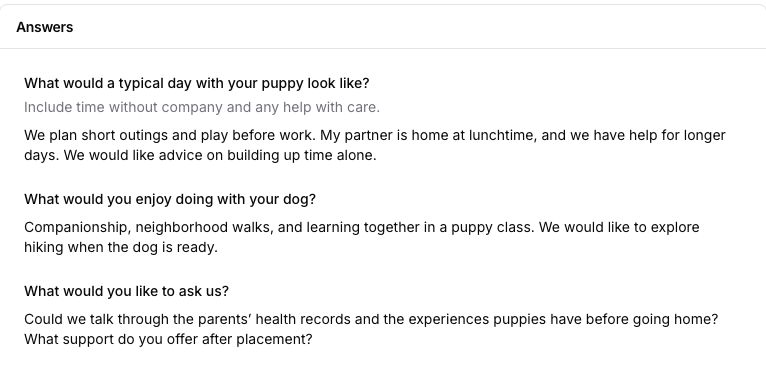
- Online forms (Google Forms, Jotform, or your website) are easiest for buyers and simplest to organize. Responses land in one place, and you can sort and search them.
- PDF applications sent via email work for breeders who prefer a more personal touch. They're easy to print and file.
- Website-embedded forms on your kennel site look the most professional and reduce friction for buyers already browsing your program.
Whichever format you choose, keep the application to 20–30 questions. Long enough to be thorough, short enough that serious buyers don't abandon it halfway through.
Key Sections to Include
Every application should cover these core areas:
- Contact information — Name, email, phone, city/state, best way to reach them
- Household details — Home type, yard/fencing, who lives in the home, ages of children, other pets
- Dog experience — Previous dogs owned, breeds, what happened to them (this question reveals a lot)
- Breed knowledge — Why this breed, what research they've done, awareness of breed-specific needs
- Lifestyle and schedule — Work schedule, activity level, travel frequency, who will be primary caretaker
- Puppy plans — Training plans, veterinarian selected, intended use (companion, sport, show, therapy)
- Financial readiness — Acknowledgment of ongoing costs (without requiring specific income disclosure)
- Contingency planning — What happens if they move, divorce, have a baby, or can't keep the dog
- References — Veterinary reference and one personal reference
Pro Tips for Your Application
End with one or two open-ended questions like "Is there anything else you'd like us to know about your family and why you want one of our puppies?" These essay-style responses are often the most revealing. Buyers who write thoughtful paragraphs are generally the ones who've done their homework.
Essential Screening Questions and What They Reveal
Not all questions carry equal weight. Some are informational. Others are diagnostic — they reveal mindset, preparedness, and potential problems. Here are the questions that experienced breeders rely on most, organized by what they actually tell you.
| Question | What It Reveals |
|---|---|
| Have you owned dogs before? What breeds, and what happened to them? | History of commitment. Rehoming patterns. Whether they understand the lifespan commitment. The "what happened" follow-up is critical — you want to hear "she lived to 14 and we still miss her," not "we had to give him up when we moved." |
| Why are you interested in this breed specifically? | Whether they've researched breed traits or just like the look. Buyers who say "I saw one on Instagram and they're so cute" need more education than those who say "I've been researching working breeds for two years." |
| Describe your typical daily schedule. | Whether the puppy will be alone for 10+ hours. Whether someone is home during the critical first months. Whether their lifestyle can accommodate exercise needs. |
| Do you have a fenced yard? If not, what's your exercise plan? | A fenced yard isn't mandatory for every breed, but the answer reveals whether they've thought about containment and exercise logistics. |
| Do you rent or own? If renting, does your landlord allow dogs? | One of the top reasons dogs are surrendered is housing changes. Renters who haven't confirmed pet policies are a risk. |
| Are there children in the home? Ages? | Not a disqualifier, but essential for matching temperament. Very young children require extra supervision planning, and certain breeds or individual puppies may not be ideal fits. |
| How do you plan to train your puppy? | Reveals their philosophy (positive reinforcement vs. outdated methods), willingness to invest in professional training, and whether they understand the time commitment. |
| Have you budgeted for veterinary care, including emergencies? | Dogs cost $1,000–$3,000+ per year in routine care. Emergency surgery can run $5,000–$10,000. Financial unpreparedness leads to neglected medical needs. |
| What will you do if you can no longer keep the dog? | The most important question on the application. The right answer is "contact you first." If they say "rehome on Craigslist" or seem confused by the question, that's a concern. |
| Are you willing to stay in touch and send updates? | Buyers who balk at ongoing communication may not value the breeder-buyer relationship. Most responsible buyers are happy to share photos and updates. |
Questions for Specific Situations
If the puppy is intended as a gift, dig deeper. Surprise puppies are one of the highest-risk placements. Confirm that the actual recipient has been involved in the decision and is fully on board.
If the buyer wants a breeding or show prospect, ask about their breeding program, mentor, breed club involvement, and what health testing they plan to do. Selling breeding stock to unvetted buyers undermines everything responsible breeders work for.
If the buyer is a first-time dog owner, don't automatically decline — but do invest extra time in education. Ask what research they've done and whether they've lined up a trainer or puppy class.
Red Flags That Should Give You Pause
Experience teaches you to trust your instincts, but it helps to have a concrete list of warning signs. Not every red flag is an automatic rejection — some are opportunities for conversation. But when you see multiple flags from the same buyer, pay attention.
High-Concern Red Flags
- They refuse to fill out the application. If someone won't invest 15 minutes in a questionnaire, they're unlikely to invest 15 years in a dog.
- They want the puppy immediately. "Can I pick it up this weekend?" from someone who contacted you yesterday suggests impulse buying, not preparation.
- They focus exclusively on price. Responsible buyers ask about health testing, temperament, and your program first. Buyers who open with "what's your lowest price?" are often shopping for a deal, not a family member.
- They have a history of rehoming dogs. One rehoming due to extreme circumstances is understandable. A pattern is a pattern.
- They want it as a surprise gift. Puppies should never be surprises. The recipient must be an active participant in the decision.
- They're vague about their living situation. Evasive answers about housing, landlord policies, or fencing suggest they know their situation isn't ideal.
- They push back on your contract terms. Buyers who argue about spay/neuter clauses, return policies, or right of first refusal are telling you they don't share your values.
Moderate-Concern Red Flags
- They've never owned a dog before. Not disqualifying, but warrants extra conversation about what they're getting into.
- Their work schedule means the puppy will be alone 8+ hours daily. Ask about their plan — doggy daycare, dog walkers, and flexible work arrangements are all valid solutions.
- They have very young children (under 3). Again, not automatic grounds for rejection, but you need to discuss supervision, appropriate puppy temperament, and realistic expectations.
- They want a specific color or gender and nothing else matters. Buyers focused solely on aesthetics rather than temperament and health priorities may need educating.
- They're impatient with your screening process. Any responsible buyer should understand why you're careful. Irritation with the process is itself a warning sign.
How to Decline Gracefully
Turning down a buyer is uncomfortable but necessary. Keep it professional and brief: "Thank you for your interest in our program. After reviewing your application, we don't feel this is the right match at this time. We wish you the best in finding the right puppy for your family."
You don't owe a detailed explanation. If they push, you can mention general concerns without getting specific. And trust your gut — if something feels wrong, it probably is.
The Multi-Stage Interview Process
A written application tells you what people want you to know. Conversations reveal what the application doesn't.
Stage 1: Initial Contact (Text or Email)
Most inquiries start digitally. Use this stage to share your application, answer basic questions about your program, and gauge the buyer's tone and responsiveness.
What to look for: Do they reply promptly? Do they ask thoughtful questions? Are they respectful of your time? First impressions matter.
Stage 2: Phone or Video Call (15–30 Minutes)
Once you've reviewed a promising application, schedule a call. This is where you fill in the gaps, clarify answers, and get a sense of the person beyond their written words.
Key conversation points:
- Walk through any application answers that need clarification
- Discuss the breed's specific needs, exercise requirements, and temperament
- Talk through their training plans in more detail
- Share your expectations as a breeder (contract terms, spay/neuter, updates)
- Ask if they have questions about your program, health testing, or socialization protocols
What to look for: Enthusiasm balanced with realism. Willingness to listen and learn. Honest acknowledgment of challenges ("We both work, but my mother-in-law lives next door and will help with the puppy during the day").
Stage 3: In-Person or Virtual Home Visit
For local buyers, a home visit — either at your place or theirs — is invaluable. You see the yard, the fencing, the living space. You meet the whole family, including the other pets. You watch how they interact with your dogs.
For out-of-state buyers, a video call where they walk you through their home and yard serves a similar purpose. Ask to see the space where the puppy will sleep, the yard or outdoor area, and any existing pets.
What to look for: Is the home safe and clean? Is the yard securely fenced? Do family members seem aligned on the decision? Are existing pets well-cared-for?
Not every sale requires all three stages. Returning buyers, breeder referrals, and people you know through breed clubs may need less formal vetting. Use your judgment — but when in doubt, do more due diligence, not less.
Managing Your Waitlist Like a Pro
A well-managed waitlist keeps buyers engaged, reduces anxiety, and prevents the chaos of trying to remember who wanted what when you're running on two hours of sleep during whelping week.
Choose Your System
Your waitlist management system can be as simple or sophisticated as your operation demands:
- Spreadsheets work for small programs (1–3 litters per year). Track buyer name, contact info, deposit date, preferences (gender, color, temperament), and status.
- Dedicated breeder software like BreedTracker centralizes your waitlist alongside litter records, buyer communication, and contracts — so you're not juggling five different tools when placement day arrives.
- CRM tools (like a simple Trello board) can work if you're already comfortable with project management software.
The key is having one source of truth. Scattered notes across Facebook messages, email threads, and sticky notes guarantee you'll forget someone or make a promise you can't keep.
First-Come vs. Best-Match: The Hybrid Approach
Most breeders use a hybrid system. Deposit order establishes priority, but final placement is based on temperament matching. Here's how to communicate this clearly:
"We honor waitlist order for pick priority. However, we reserve the right to match puppies to families based on temperament, lifestyle, and the puppy's individual needs. A family that is #3 on the list may receive a puppy before #2 if the temperament match is stronger."
Spell this out in writing before you take a single deposit. Buyers who understand the system upfront rarely have problems with it.
Communication Cadence
Silence breeds anxiety — and anxious buyers send a lot of emails. Set expectations early and then deliver consistent updates:
- At deposit: Confirm receipt, explain the timeline, share expected breeding/whelping dates
- Breeding confirmed: Quick update that the breeding took place
- Pregnancy confirmed: Share the news and estimated due date
- Puppies born: Number, genders, and a first photo within 24–48 hours
- Weekly updates: Brief photo/video updates as puppies develop
- Selection day details: Explain the process, timeline, and temperament evaluation results 2–3 weeks before pick day
- Go-home prep: Instructions, what to bring, pickup logistics
A buyer who receives regular updates is a happy buyer. One who hasn't heard from you in six weeks is writing a negative review.
Regular Check-Ins with Waiting Buyers
For waitlists that span multiple litters or many months, check in every 8–12 weeks to confirm buyers are still interested. Life changes fast — people move, divorce, get new jobs, or adopt a dog from somewhere else. A quick email ("Hi Sarah, just checking in — are you still interested in a puppy from our next litter? Please confirm by [date] to hold your spot.") keeps your list clean and your planning accurate.
Deposit Policies That Protect Everyone
Deposits serve two purposes: they confirm buyer commitment and compensate you for turning away other applicants. A clear policy prevents 90% of deposit-related drama.
How Much to Charge
Most breeders charge between $300 and $500 as a deposit, though the range extends from $200 to $1,000+ depending on breed and purchase price. A common benchmark is 10–25% of the total puppy price. The deposit should be significant enough to deter non-serious buyers but not so large that it creates a financial barrier for genuinely qualified families.
Refundable vs. Non-Refundable
There are three common approaches:
- Fully non-refundable: The simplest policy. Deposit is forfeited if the buyer backs out for any reason. This strongly deters non-committed applicants.
- Partially refundable: For example, $200 of a $500 deposit is non-refundable, and $300 is refunded if the buyer cancels before puppies are born. After whelping, the full deposit is non-refundable.
- Transferable: Deposit rolls forward to a future litter if no suitable puppy is available in the current litter. This is the most buyer-friendly approach and builds long-term relationships.
Whichever structure you choose, put it in writing before you accept a single dollar. Include your deposit policy in your application packet, on your website, and in the deposit receipt.
When to Collect Deposits
The most common timing:
- After application approval and interview — Deposit confirms the buyer's spot on the waitlist
- Before or during pregnancy — Buyers commit to a specific litter
- After puppies are born — Some breeders wait until puppies are on the ground before taking deposits, which reduces the risk of needing to manage expectations about litter size
What to Include in a Deposit Receipt
- Buyer name and contact information
- Deposit amount and date received
- Payment method
- Refund/cancellation terms
- What the deposit is applied toward (purchase price)
- Expected timeline for puppy availability
- Your signature and the buyer's signature
Matching Puppies to the Right Homes
Temperament matching is where the art of breeding meets the science of placement. The right match creates a lifelong bond. The wrong match creates frustration, behavioral problems, and returns.
Temperament Testing at 7–8 Weeks
The Volhard Puppy Aptitude Test (PAT) is the most widely used standardized temperament assessment. Conducted at approximately 7.5 weeks of age, it evaluates ten behavioral traits:
- Social attraction
- Following
- Restraint response
- Social dominance
- Elevation dominance
- Retrieving tendency
- Touch sensitivity
- Sound sensitivity
- Sight sensitivity
- Stability/startle recovery
Each item is scored on a 1–6 scale. Puppies scoring mostly 1s and 2s are bold, dominant, and high-drive — best suited for experienced handlers, sport homes, or working environments. Puppies scoring mostly 3s and 4s are confident but adaptable — ideal for active families and first-time owners who are committed to training. Puppies scoring mostly 5s and 6s are more sensitive and submissive — well-matched with calm households, elderly owners, or therapy work.
Beyond the Test: Your Daily Observations
Standardized tests capture a snapshot. Your eight weeks of daily observation capture the full picture. Note which puppies are:
- First to the food bowl vs. hanging back
- Bold explorers vs. cautious observers
- Rough with littermates vs. gentle in play
- Quick to recover from startling sounds vs. slow to rebound
- Comfortable being handled vs. resistant to restraint
These observations, combined with formal test scores, give you a nuanced temperament profile for each puppy.
Matching Temperament to Lifestyle
| Buyer Profile | Best Temperament Match |
|---|---|
| Active, experienced dog owner — hiking, running, dog sports | Bold, high-drive puppy (scores 1–2) with strong retrieve and social confidence |
| Family with young children | Moderate, resilient puppy (scores 3–4) with high touch tolerance and quick startle recovery |
| First-time dog owner, suburban home | Adaptable, biddable puppy (scores 3–4) with moderate energy and strong social attraction |
| Retired couple, quiet lifestyle | Calm, gentle puppy (scores 4–5) with lower energy and strong human attachment |
| Therapy or service dog candidate | Confident but not dominant (scores 3) with high social attraction, low sound/sight sensitivity |
| Show or breeding prospect | Structurally correct puppy with confident, outgoing temperament and good stack tolerance |
Why Breeder-Picks Produce Better Outcomes
Many experienced breeders have moved to a breeder-picks model where the breeder assigns puppies to families rather than letting buyers choose. The reason is simple: you know the puppies better than anyone. You've watched them develop for eight weeks. You understand the subtle differences in drive, resilience, and social style that buyers can't assess in a 30-minute visit.
Communicate this early and frame it as a benefit: "We match each puppy to the family where it will thrive best. Our eight weeks of daily observation and formal temperament testing allow us to make matches that set both the puppy and your family up for a lifetime of success."
Puppy Contracts That Cover All the Bases
A solid contract protects you, the buyer, and the puppy. It also sets clear expectations that prevent misunderstandings down the road. Have an attorney review your contract, especially if you sell across state lines — animal sale laws vary by jurisdiction.
Essential Contract Clauses
| Clause | What to Include |
|---|---|
| Identification | Puppy's registered name, breed, color/markings, date of birth, microchip number, registration number |
| Purchase price and payment terms | Total price, deposit credited, balance due date, accepted payment methods |
| Health guarantee | Duration (typically 1–2 years for genetic conditions), covered conditions, required documentation (OFA/PennHIP at appropriate age), and remedy (refund, replacement, or vet cost reimbursement). Specify that buyers must provide veterinary documentation of any claimed condition. |
| Spay/neuter requirement | Required age or timeline for pet-quality puppies. Many breeders now specify age-appropriate timing (12–18 months for larger breeds) based on current orthopedic research. Include consequences for non-compliance (typically a financial penalty). |
| Right of first refusal | If the buyer can no longer keep the dog at any point in its life, the dog must be offered back to you before any other rehoming occurs. This is non-negotiable for responsible breeders. |
| No resale clause | The buyer may not sell, give away, or transfer the dog to a shelter, rescue, or third party without your written consent. |
| Registration terms | Whether the puppy is sold on limited or full registration. Conditions for upgrading to full registration (completion of health testing, titling requirements). |
| Care requirements | Veterinary wellness exam within 72 hours of pickup, required vaccination schedule, feeding guidelines, exercise restrictions for growing puppies, and any breed-specific care requirements. |
| Co-ownership terms (if applicable) | Specific obligations of each party, breeding rights, litter-back arrangements, and conditions for transfer of full ownership. Be extremely detailed — vague co-ownership agreements cause the worst disputes. |
| Breach and remedy | What constitutes a breach of contract and what happens — typically forfeiture of registration papers, financial penalty, or requirement to return the dog. |
Health Guarantee Best Practices
The strongest health guarantees are specific, not vague. Rather than "guaranteed healthy," specify exactly which conditions are covered — hip dysplasia, elbow dysplasia, cardiac conditions, eye conditions, breed-specific genetic diseases — and outline the process for making a claim.
Most breeders require the buyer to obtain a veterinary diagnosis, provide supporting documentation (radiographs, specialist exam results), and notify the breeder within a specific timeframe. Remedies typically include one of the following:
- Full or partial refund with return of the dog
- Replacement puppy from a future litter
- Reimbursement of veterinary expenses up to the purchase price
- Some combination of the above, at the breeder's discretion
Include a clause requiring buyers to keep the puppy on a veterinarian-recommended wellness schedule. A health guarantee shouldn't cover conditions that result from owner negligence — missed vaccinations, inappropriate exercise, or dietary mismanagement.
Go-Home Day: Setting Everyone Up for Success
The go-home experience shapes how buyers remember you and how well the puppy transitions. A smooth, well-prepared go-home day is the final chapter of your screening and placement story.
The Puppy Packet
Every puppy should leave with a comprehensive take-home packet. This is your opportunity to demonstrate professionalism and give new owners everything they need in one organized package.
Documents to include:
- Signed copy of the purchase contract
- Health records (vaccinations, dewormings, vet exam results)
- Registration application or papers
- Pedigree (3–5 generation)
- DNA/genetic test results for the parents
- Written feeding schedule with specific food brand, amount, and frequency
- Housetraining and crate training guide
- Socialization continuation checklist — see our complete socialization protocol for what to include
- Your contact information with preferred communication method
- Emergency veterinary contact information
- Pet insurance information or complimentary trial
Physical items to include:
- 3–7 days' supply of the puppy's current food (to prevent digestive upset during transition)
- A blanket or cloth with the dam's scent and littermate scent
- One or two familiar toys the puppy has been playing with
- A small bag of treats
- Collar and ID tag (optional but appreciated)
Go-Home Day Logistics
Schedule pickups individually — don't let five families show up at the same time. Allow 30–45 minutes per family for:
- Reviewing the contract together and signing
- Walking through the puppy packet contents
- Demonstrating how the puppy is currently being fed
- Discussing the first 48 hours at home (expect crying, possible loose stool, reduced appetite)
- Answering last-minute questions
- Taking photos of the new family with their puppy
Send buyers home with realistic expectations: "The first three nights are the hardest. Your puppy will cry. That's normal. Here's what to do..."
Post-Placement Follow-Up: The Work Isn't Over
Your relationship with buyers shouldn't end at the driveway. Ongoing follow-up serves three purposes: it supports new owners during the critical adjustment period, it helps you track health outcomes in your lines, and it builds the kind of reputation that fills future waitlists without advertising.
Suggested Follow-Up Schedule
- 24–48 hours post-pickup: Quick text or call — "How was the first night? Any questions?"
- 1 week: Check in on eating, sleeping, and adjustment
- 1 month: Ask about veterinary wellness exam results and training progress
- 6 months: Request updated photos and check on growth, temperament development
- 1 year: Birthday check-in — most owners love this touch
- Annually thereafter: Brief check-in to maintain the relationship
Building Your Breeder Network
Buyers who feel supported become your best ambassadors. They refer friends, leave glowing reviews, and come back for their second (and third) puppy. They also become your eyes and ears on the health and temperament of your dogs in the real world — information that makes your breeding program stronger with every generation.
Create a private Facebook group or email list for your puppy families. Share training tips, celebrate milestones, and build a community around your program. This ongoing connection is one of the most powerful marketing tools a breeder can have — and it costs nothing but genuine care.
Frequently Asked Questions
How many questions should a puppy buyer application have?
Aim for 20–30 questions covering housing, experience, lifestyle, training plans, financial readiness, and contingency planning. Too few questions miss critical information. Too many discourage applicants. Most breeders find the sweet spot is a 2–3 page form that takes 15–20 minutes to complete thoughtfully.
How do breeders decide who gets a puppy?
Most breeders use a hybrid system: deposit order establishes waitlist priority, but final puppy assignments are based on temperament matching. The breeder evaluates each puppy's temperament at 7–8 weeks and matches it to the family whose lifestyle, experience, and goals are the best fit. A calm, sensitive puppy goes to the quiet retired couple, not the household with four kids under age 7.
Should puppy deposits be refundable or non-refundable?
This varies by breeder. Fully non-refundable deposits are the most common, but many breeders offer a partially refundable structure — for example, $200 non-refundable with the remaining $300 refundable if the buyer cancels before a specific milestone (such as puppies being born). Whichever policy you choose, put it in writing and communicate it clearly before accepting payment.
What should I do if a buyer breaks the contract?
Document the breach with evidence (screenshots, veterinary records, photos). Contact the buyer directly and reference the specific contract clause. Most breaches can be resolved through direct conversation. For serious violations — breeding a dog sold on limited registration, surrendering a dog to a shelter — consult your attorney. Some breeders include financial penalty clauses for specific breaches, which gives you leverage even if litigation isn't practical.
When should I start taking deposits for a litter?
Timing varies. Some breeders take deposits before breeding, based on a planned pairing and established waitlist. Others wait until pregnancy is confirmed by ultrasound (around day 28–30). Still others wait until puppies are born and a final count is known. Earlier deposits help with financial planning but carry the risk of more cancellations if the breeding doesn't take or the litter is smaller than expected.
How do I handle a buyer I've already approved but now have concerns about?
Trust your instincts. If new information emerges after approval — a changed living situation, concerning social media posts, or red flags during follow-up conversations — you have the right to refund the deposit and decline the placement. A returned deposit is far less costly than a bad placement. Be professional, keep it brief, and don't feel obligated to justify your decision in detail.
Key Takeaways
- Screening protects your puppies, your reputation, and your sanity. A structured application and multi-stage interview process filters out unprepared buyers before they become problems.
- Ask diagnostic questions, not just informational ones. What happened to their last dog, what they'll do if they can't keep this one, and how they react to your contract terms reveal more than any checkbox answer.
- Red flags are data, not insults. Declining a buyer isn't personal — it's responsible stewardship. Trust your instincts when something feels off.
- Manage your waitlist with one system, clear policies, and consistent communication. Silence breeds anxiety. Regular updates keep buyers happy and your list clean.
- Deposits should be significant, clearly documented, and governed by a written policy. Most breeders charge $300–$500 as a non-refundable deposit that applies toward the purchase price.
- Temperament matching produces better outcomes than buyer-picks. Use the Volhard PAT or similar standardized test at 7–8 weeks, combined with your daily observations, to match each puppy to the right home.
- Your contract is your safety net. Include health guarantees, spay/neuter requirements, right of first refusal, and clear breach consequences. Have an attorney review it.
- Go-home day is your final impression. A professional puppy packet, realistic expectations, and a warm send-off turn buyers into lifelong ambassadors for your program.
- Follow up after placement. The breeder-buyer relationship doesn't end at pickup. Ongoing support builds your reputation and gives you invaluable data on your breeding outcomes.
Ready to breed with confidence?
BreedTracker helps you track heat cycles, interpret progesterone results, and determine the perfect breeding window for your dogs.
Free forever · Up to 4 litters/year · No credit card required
Related Articles
How to Choose a Stud Dog: A Breeder's Guide
Stud dog selection guide covering pedigree analysis, COI, linebreeding vs outcrossing, progeny evaluation, stud fees, contracts, and semen shipping.
Read morePuppy Socialization: Week-by-Week Breeder Protocol
Week-by-week puppy socialization protocol covering ENS, Early Scent Introduction, Puppy Culture, the Rule of Sevens, and temperament testing for breeders.
Read more